Showing posts with label automobile. Show all posts

Wednesday, February 9, 2022

History of Chevrolet

Chevrolet was founded in Detroit, in November 1911, by Louis Chevrolet, a race car driver, and General Motors founder William C. “Billy” Durant. They combine their knowledge of cars and business to develop cars that quickly earned reputations for performance, durability and value.

It all started on November 3, 1911 when Chevrolet Motor Company of Michigan became incorporated. Although the Chevrolet Motor Company was founded in Detroit, the first Chevy factory was actually built nearby, at the corner of Wilcox and Kearsley Street in Flint, Michigan.

Chevrolet was well known and had a reputation for being a daring driver. He set the land speed record in 1905 after reaching speeds of 111 mph. Chevrolet himself was a Swiss race car driver who also happened to be an engineer,

In Chevy’s first production year, 1912, the price for their models was $2,150, a lot of money during the early days of automobile manufacturing. In 1913, the Chevrolet bowtie logo was created. It was first used in 1914, on the H Series Baby Grand, the Royal Mail, and the Light Six L Series.
In 1916, Chevy manufacturing had grown to 70,000 units and 125,882 units the following year. In 1918, Chevrolet introduces its first truck, based on the Model 490 car chassis.

On May 2, 1918, General Motors Corporation (GM), which will become the world’s largest automotive firm, acquires Chevrolet Motor Company.

Chevrolet died in 1941 at the age of 63. With the car like 1953 Corvette, 1955 Bel Air Sport Coupe, 1969 Camaro, 1970 El Camino SS, 1970 Chevelle SS, and countless others, the brand is recognized around the world for its American ingenuity, quality, and innovation.
History of Chevrolet

Saturday, August 14, 2021

The Cadillac

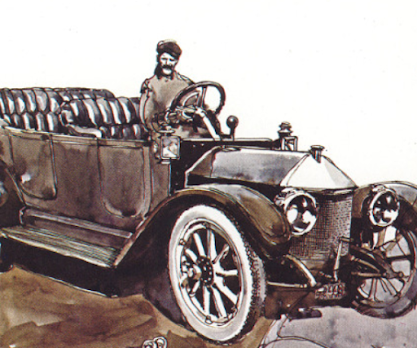
The first gasoline automobile to ply the streets of Detroit was a lightweight horseless carriage with cow-tail (tiller) steering, built by Charles Brady King and German immigrant, Oliver Barthel. While at Chicago World’s Fair in 1893, he saw the self-propelled carriage designed and built by Gottlieb Daimler, inspiring him to begin designing his own car in Detroit. He test drove the first self-propelled carriage along Woodward Avenue and reached speeds up to five miles per hour.

That event occurred March 6, 1896 when that first "car" puttered down Woodward Avenue in Detroit with King at the tiller and (engineer) Barthel seated at his side.

King lacked the resources to refine his experimental vehicle into a production car and at the same time with their experience of the gasoline-powered car, he and Oliver Barthel was invited to give an opinion on the chances of survival of Henry Ford's first, modest venture into building automobiles.

Around the same time Henry Martyn Leland an American machinist, inventor and engineer, who was VP and general manager of the Leland & Faulconer Manufacturing Company, a budding tool and die manufacturer, convinced Ford's investors that there was a future in horseless carriages, provided they could be powered by a reliable motor ...and Leland had one.
His robust little single cylinder engine would soon be proving its mettle in the fledgling motor works of Ransom Eli Olds. Ransom Olds refused to accept the more powerful engine because it would have required radical changes in his car’s design, thus prompting Leland to go into automobile business for himself Leland’s Cadillac, the first mass-produced car with truly interchangeable parts. Later that year, the Detroit Automobile Company was founded.

Saved from bankruptcy two years later (1901) by Henry Leland, the Detroit Automobile Company was renamed the Cadillac Automobile Company, in August 1902.

The name Cadillac was selected in honor of Le Sieur Antoine de la Mothe Cadillac, a French explorer who founded the city of Detroit, a small French trading post at the confluence of lakes Erie and St. Clair on July 24, 1701.

Oliver Barthel was kept on by Leland although credit for the earliest Cadillac automobiles went to another engineer by the name of Alanson P. Brush.

During September 1902, production began on the first Cadillac automobile, the Model A one cylinder. The first Cadillac was completed on October 17, 1902.
During the first year of production of 1903-1904, the Cadillac Automobile Company built and shipped 1,895 finished vehicles to the American consumers. By 1904, all Cadillac vehicle power plant mechanisms were manufactured by Leland & Faulconer. In late 1904, the Cadillac Automobile Company and Leland & Faulconer merged to form the Cadillac Motor Car Company. CEO was Henry M. Leland.

In 1910, Cadillac became a division of General Motors, and during that year, the closed body was introduced as standard equipment. Traditionally, Cadillac’s have been large, elegantly styled, and luxuriously furnished vehicles with state-of-the-art features. It became the high-priced luxury line in the GM family of automobiles.
The Cadillac
Saturday, May 8, 2021

Ford Motor Company

Henry Ford (1863 – 1947) was a pioneer in business and entrepreneurship. Having an extreme talent and desire for engineering, he became an employee of the Detroit Edison Company in 1890 and eventually became chief engineer of the company.

A self-trained mechanic with a lifelong disdain of experts with university degrees, Henry Ford built his firsts automobile in 1893. In 1903 Ford and 11 business associates established Ford Motor Company. At that time, the US was home of 87 other car companies.

He intended to produce “the car for the great attitude,” and to do he had to harmonies mass production with mass consumption. Ford’s genius was to recognize that with the right technology, cars can be made available to the public at an affordable price. He focused on making the process more efficient and as a result produced more cars and charged lower prices.

Ford was not the first manufacturer to use interchangeable parts or to run an assembly line, but in his quest to produce an inexpensive and standardized product he perfected assembly line production techniques.

The result proved dramatic. In 1908, before he introduced the assembly line, Ford made 10,607 Model Ts – the “Tin Lizzie” – which he sold for $850 each. He shifted to an assembly line in 1913, and production quickly rose to 300,000 cars a year.

In 1916 he sold 730,041 Model Ts for $360 each, and in 1924 he produced two million of the cars retailing at $290 each. A total of fifteen million Model Ts rolled out of Ford plants before production ceased in 1927.

Demand for this car was so great that Ford developed new mass production methods in order to manufacture it in sufficient quantities.

Prior to Ford, it took over twelve hours to assemble a car. By contrast his first assembly line turned out a model T every 93 minutes, and by 1927 Ford was making a Model T every 24 seconds.

In 1922, Ford bought Lincoln Motor Company, named after Abraham Lincoln, for $8 million. Lincoln became the first "outsider" to join the Ford family of vehicle brands and initiated the company's entrance into the luxury market.

The Ford Motor Company became not only the word’s largest automobile manufacturer but the world’s largest industrial enterprise.
Ford Motor Company

Saturday, April 10, 2021

Oldsmobile in history

"Oldsmobile" - a brand of cars, most of its existence, the corporation owned by General Motors.

Originally established as Olds Motor Vehicle Company, the company was founded in 1897 and existed until 2004. During its 107-year history, the company produced 35.2 million vehicles, of which about 14 million at its plant in Lansing.

Ransom E. Olds (1864-1950), an Ohio-born engine maker, founded the Olds Motor Vehicle Company in Lansing. He built his first steam powered vehicle in 1887 and the first gasoline vehicle in 1896. He was a pioneer in mass production in the automobile industry.

The company built a plant in Detroit and began producing a car built to sell for $1250.

In 1901, the company, then known as Olds Motor Works, debuted the Curved Dash Oldsmobile, a gas-powered, open-carriage vehicle named for its curved front footboard.

The car surpassed the steam Locomobile as America’s best-selling car in 1902, when 2,750 of them were sold.

Ransom Olds left the company in 1908, and General Motors (GM) acquired Oldsmobile in after Oldsmobile had been struggling financially. Oldsmobile was slotted between Chevrolet; less expensive, and Buick; more expensive.

April 29, 2004, was the last day Oldsmobile comes off from the assembly line.
Oldsmobile in history

Saturday, March 27, 2021

Buick: A division of General Motors

David Dunbar Buick, brought by his parents to the United States from Scotland at age 2, had been a successful plumbing inventor and manufacturer in Detroit when his head was turned by gasoline engines in the late 1890s.

He started Buick Auto-Vim and Power Company in 1898, and the company initially concentrated on making engines. In 1902 the company was awarded a patent for an automotive overhead valve engine.

The first automobile was built in 1900. In 1903, Buick found a group of wagon makers in Flint, Michigan, willing to take the risk and buy his company. Buick Motor Division incorporated May 19, 1903 in Flint, Michigan.

In May and June of 1904, the company built the first Flint Buick. Buick began producing the Model B Touring Cars, its first retail model, that summer and built 37 cars by the end of 1904.

By 1906, Buick was building 4,600 automobiles a year. 1907 saw Henry Ford introduce his famous Model T. Buick countered Ford’s success with the Model 10. In 1908, Buick became number one automobile producer surpassing Food and Cadillac.

By the 1920s, Buick was becoming the car of choice for kings, sultans and political leaders and winning competitions from South America to Australia to the Soviet Union.

Buick built aircraft engines, Hellcat tank destroyers and other military hardware, when United States entered World War II. In the 1970s and 1980s Buick started producing smaller and midsize cars to meeting the demand of the American car buyer for fuel economy.
Buick: A division of General Motors

Saturday, February 27, 2021

History of General Motors

In 1904, William Crapo Durant assumed management of Buick, a local car company with great potential but plagued with struggling production and heavy debt.

After he failed to convince Henry Ford and Ransom E. Olds to join him in an organization, Durant decided to form his own holding company, General Motors in the fall 1908.

It began as a holding company for Buick, but grew rapidly from there. In the first year of GM’s existence, it acquired Oldsmobile, Cadillac, Elmore, and Oakland (the precursor to Pontiac). GM was always in the business of buying other companies to incorporate. It believed by bringing in companies with different attributes, then they would be able to reach a broader market.

In 1911, GM formed General Motors Truck (later GMC), and in 1918, it acquired Chevrolet Motor Company and launched GM of Canada. GM introduced the electric self-starter commercially in its 1912 Cadillac.

In 1916, he set up a separate subsidiary called United Motors to buy small, successful parts companies. His first acquisitions included Delco, which held Charles Kettering’s patents to the automotive self-starter.

Durant ultimately bought about 20 supplier companies; his last acquisitions – in 1919, the year before he was ousted as GM’s CEO – was Fisher Body. Durant was forced out of the company in 1920 and was succeeded by Alfred P. Sloan, Jr., who served as president and then as chairman of the board of directors.

General Motors ushered in the age of mass consumerism with its installment buying and credit programs for car buyers in the 1920s. Coupled with its expansive lineup of cars – from humble Chevrolet to the mighty Cadillac – and yearly style changes, GM’s approach to selling cars was adapted throughout the industry as the standard for mass marketing durable goods to the U.S consumer.

Unlike Henry Ford who closely monitored nearly every business move made by his many dealers, Durant afforded his distributors a great deal of leeway especially when it came to handling everyday business matters. He only interfered when a dealer no longer generated sufficient profit returns.

After 1930 the company was ranked as the nation’s largest car maker, ahead of rival Ford Motor Company and the Chrysler Corporation.

By 1941 it was making 44 percent of all the cars in the United States and had become one of the largest industrial corporations in the world.

World War II brought more change to General Motors. In 1942, GM supplied over $12.3 billion in war material, including airplanes, engines, trucks, tanks, guns, and shells.
History of General Motors

Popular Posts

Selected articles